


OUR SERVICES
Your Production Integrators in Europe
We are the central hub
We work with different types of clients, adapting each project to their needs, scale and objectives.
• Brands • Designers • Stores • Influencers • New businesses


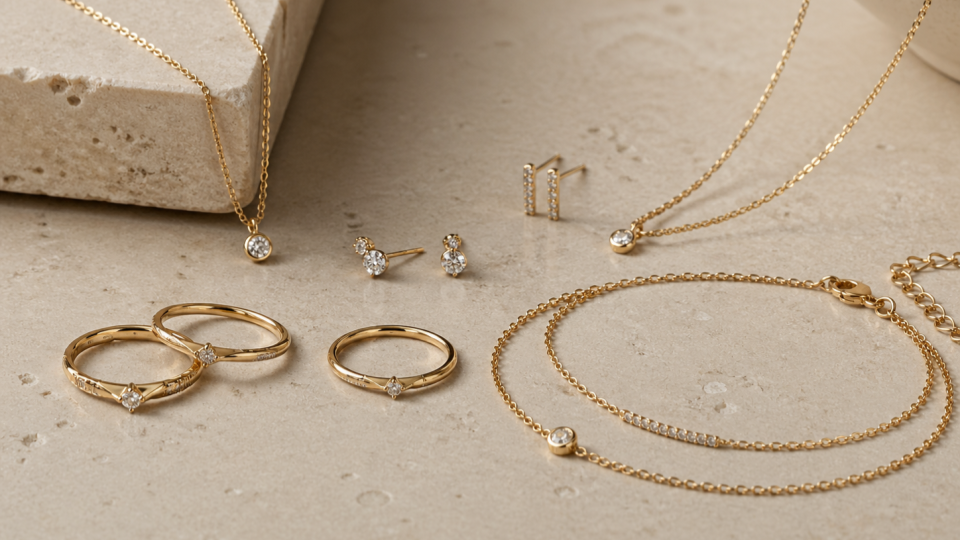
Custom Jewelry
Custom jewelry pieces developed for each project, from simple designs to more complex concepts.
We adapt every detail to the style, materials and final objective of the client.
• Rings
• Necklaces
• Bracelets
• Earrings
• Pendants
Full Collections
Complete jewelry collections developed from the initial idea to a final product ready to launch.
We create cohesive sets designed to work as a brand.
• Coordinated collections
• Product lines
• Brand-ready sets
• Scalable designs




Pins
Custom metal pins designed for brands, merchandising and collections.
Each piece is adapted in shape, size and finish to match the identity of the project.
• Logo pins
• Custom shapes
• Limited editions
• Brand elements
Metal Accessories
Metal components for fashion, accessories, and product design.
Both functional and decorative elements are adapted to different applications.
• Buckles
• Brooches
• Closures
• Decorative hardware


Sculptures
Development of sculptural pieces, from small objects to larger projects.
Each piece is approached according to its scale, purpose, and context.
• Small sculptures
• Decorative pieces
• Artistic projects
• Large-scale works
Grills
Custom grills designed according to each client’s style and preferences.
From simple designs to more complex and expressive pieces.
• Simple grills
• Full sets
• Custom designs
• Different finishes


Merchandising
Metal products developed for brands, companies, and promotional use.
Designed to be functional, recognizable, and aligned with the brand image.
• Keychains
• Coins
• Medals
• Corporate gifts
3D Printing
3D printing solutions for prototyping and development processes.
Used to validate designs or prepare pieces for further production.
• Resin printing
• Wax printing
• Prototypes
• High-detail models


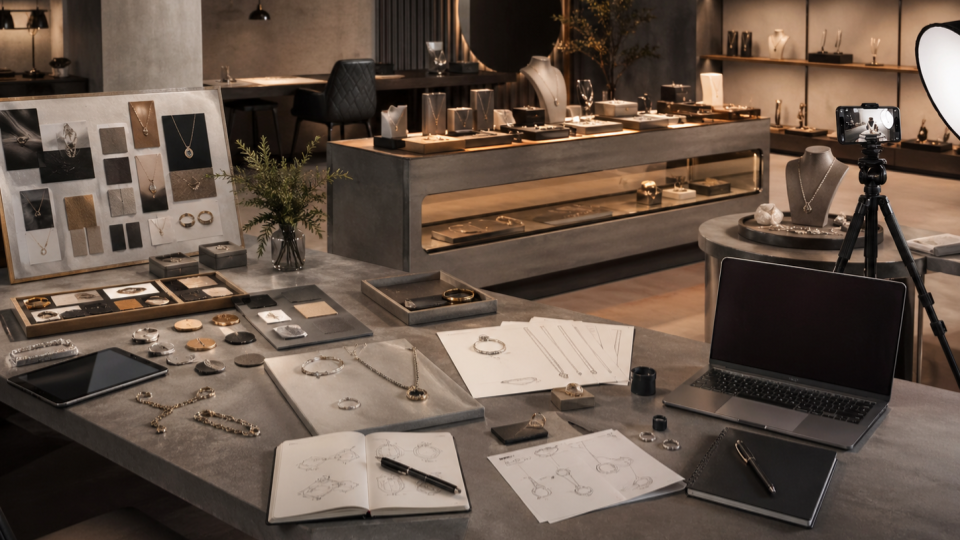
Full Service
Complete support for clients who need guidance throughout the entire process.
From the initial idea to the final product, we help define and develop every step.
• Project definition
• Material selection
• Development process
• Final product

3D scanner for jewelry and costume jewelry
3D scanning allows for the digitization of physical pieces of jewelry and costume jewelry, generating an accurate digital file that can be used for reproduction, modification, or technical archiving. This system captures volumes, proportions, and details of the original piece, facilitating its adaptation to new sizes, correction of imperfections, or preparation for processes such as 3D printing or casting. It is especially useful when you want to replicate an existing piece, redesign it, or integrate it into a collection while maintaining formal consistency. The resulting file can then be optimized in a 3D design environment to ensure that it is technically feasible according to the chosen production system.
.png)


.png)


3D printing in resin for casting
3D printing in resin for casting allows models to be generated directly from a digital file using materials designed to burn completely during the microfusion process. It's a versatile solution that can be used for both single pieces and large production runs, as it allows for direct reproduction from a digital file without the need to manufacture a traditional silicone or rubber mold. This reduces initial costs and eliminates tooling time. One of its main advantages is its economic efficiency and productive flexibility, especially in projects where continuous modifications, customizations or replacements are expected. As a technical limitation, very fine engravings or extremely superficial details may lose definition during the calcination and casting process if they are not specifically designed for this system. Therefore, the design must be adapted taking into account the material's behavior during casting. It is a suitable technical option when seeking speed, scalability and reduced initial investment without compromising the repeatability of the model.
3D wax printing
3D wax printing allows the generation of physical models directly from a digital file, using specific materials formulated for subsequent casting processes. It is a solution especially useful in jewelry, costume jewelry, accessories, and small sculptures when high precision, repeatability, and fidelity to the original design are required. It allows for the creation of complex geometries that would be difficult to produce through manual modeling. Wax-printed parts are commonly used in processes such as microcasting, facilitating the production of both unique units and small and medium series. This system combines digital technology and traditional casting, optimizing development times and dimensional control from the design phase.


3D Design
3D design allows a piece to be digitally developed before it is manufactured, precisely defining measurements, proportions, volumes, and technical details. It is a key phase in jewelry, costume jewelry, accessories and sculpture projects, as it allows you to visualize the final result, make prior adjustments and optimize the design according to the planned production system (microfusion, 3D printing, traditional casting, etc.). Working in a digital environment facilitates the modification of models, the customization of parts, and the preparation of files ready for printing or manufacturing, reducing errors and development times. It can be applied to both individual pieces and complete collections, being the technical basis on which the entire subsequent production process is structured.
3D printing in resin for prototypes
3D printing in resin for prototypes allows a digital design to be materialized with high precision and a good level of detail, with the aim of validating shape, proportions, ergonomics and aesthetics before going into production. Unlike castable resin, this type of material is not intended for casting processes, but for physical testing, commercial presentations, technical validation, or product development. It is a quick and economical solution for evaluating design adjustments, making modifications, or presenting samples to clients before investing in final manufacturing. It allows working from a single unit to multiple iterations of the same model, facilitating the development and decision-making process.


Automatic wax injection
Automatic injection or pouring of wax is a common system in sculpture projects and artistic pieces, especially when working with larger volumes or formats that do not require automation. The wax can be introduced into the mold by controlled manual injection or by direct pouring into it, adapting the process according to the size and complexity of the piece. It is a suitable solution for both the reproduction of a single sculpture and for small series, allowing the preparation of wax models that will later be used in casting processes. This method offers flexibility and artisanal control in pieces where scale and volume require a more personalized treatment.
Laser engraving
Laser engraving allows marking or customizing metal surfaces with high precision, creating texts, logos, numbers or graphic details directly on the piece. Unlike cutting, engraving does not penetrate the material, but rather modifies the surface layer of the metal using a controlled laser. It can be applied to both flat surfaces and curved interiors or exteriors, adapting to rings, bracelets, plaques, pendants or other formats with complex geometries. It is a suitable solution for personalization, numbered series, brand identity, or incorporation of technical details with high definition and repeatability.
.png)

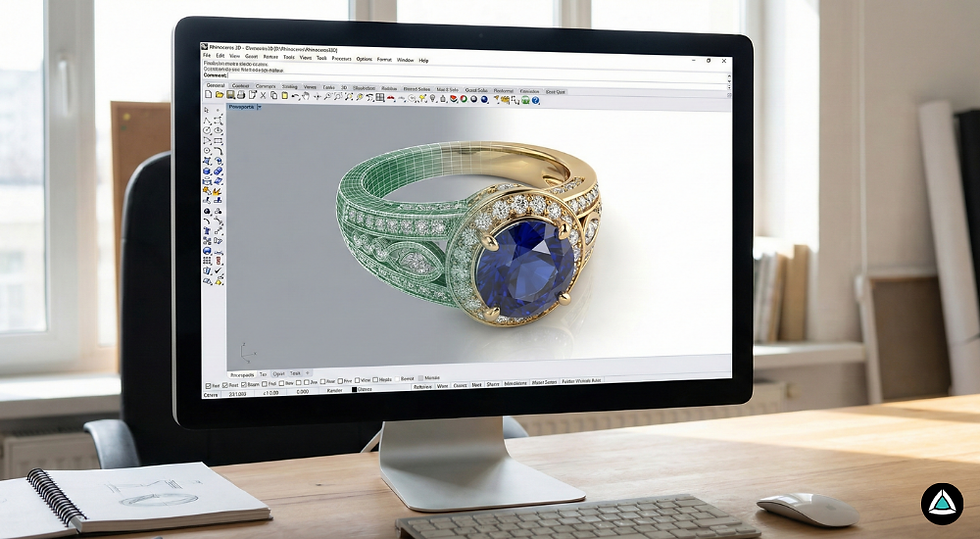
Rendering
Rendering allows the generation of realistic digital images of a part from its 3D design, before its physical manufacture. By simulating materials, lighting and finishes (gold, silver, bronze, polished surfaces, matte surfaces, stones, etc.), it is possible to visualize the final result with a high level of detail and realism. They are a useful tool for business presentations, design validation, catalog creation, e-commerce or marketing campaigns, without the need to physically produce the piece in the first phase. They allow you to quickly and efficiently display different colors, materials, or finish variations, facilitating decision-making and reducing costs in the initial stages of the project.
Laser cutting
Laser cutting allows obtaining parts or components from metal sheets with high precision and definition in the contour. It is a system used in jewelry, costume jewelry, accessories and decorative items when repeatability, clean cuts and material optimization are required. It allows working with complex designs, openwork patterns and detailed geometries with controlled tolerances, making it suitable for both individual pieces and serial production. Depending on the material and thickness, it can be applied to metals such as brass, steel, silver or other technical materials, forming part of subsequent processes such as bending, welding, finishing or assembly.


Casting of sculptures and large-format pieces
The casting of sculptures and large pieces in brass, bronze or aluminum is a process aimed at reproducing medium and large volumes, maintaining fidelity to the original model and structural resistance. This system allows for the creation of artistic works, decorative elements, or technical pieces that require greater thickness, stability, and durability. Depending on the project, different molding and casting methods can be used, adapted to the complexity of the piece and the required final finish. Bronze and brass are commonly used in sculpture because of their mechanical behavior, finish, and ability to age naturally, while aluminum offers a lighter alternative without sacrificing strength. It is a solution designed for sculptural projects and larger-scale pieces where material, weight, and structure are determining factors.
Silicone molds
Silicone molds allow for the precise reproduction of mass-produced pieces from an original design. They are a widely used solution in jewelry, costume jewelry, and accessories when a piece needs to be replicated while maintaining all its details, textures, and proportions. This system guarantees high-quality copies, dimensional stability, and efficiency in short and medium production runs. The type of silicone and the mold configuration are adapted to the subsequent process, such as wax injection or other reproduction methods. It's important to note that this type of mold results in an approximate reduction of 4% to 7% in the reproduced parts. This shrinkage must be accounted for from the initial design stage or during the manufacture of the prototype to ensure that the final dimensions are correct. It is an essential phase in projects that require scalability, aesthetic coherence, and control in the repetition of pieces.


Sand casting
Sand casting is a traditional system used primarily for sculptures and larger or more voluminous pieces. The mold is made of compacted sand around the model, allowing for the creation of large shapes and greater structural thicknesses. It is a versatile method suitable for single-unit production or very short runs. Although the surface finish usually requires subsequent refining and finishing work, it is an efficient and stable solution for large-format sculptures or pieces where scale is critical.
Framed
Setting is the process by which stones or other decorative elements are fixed in a metal piece, ensuring stability, alignment and aesthetic finish. There are different types of settings — such as claw, bezel, pavé, channel or grain — that are selected based on the design, the size of the stone and the desired visual result. It is a crucial phase in jewelry making, as it influences both the security of the fastening and the final perception of the piece's quality and precision. It can be applied to both unique pieces and serial productions, and it is essential that the prior design takes into account the tolerances and technical needs of the type of setting chosen.


Microcasting
Microcasting is a high-precision casting system used in jewelry, costume jewelry, accessories, and small sculptures. It allows for the reproduction of metal pieces from a pre-existing model, guaranteeing a high level of detail and excellent definition in fine volumes. The process involves creating a wax tree, which is then coated with refractory material. After the wax is removed using heat, molten metal is poured into the mold, resulting in a final piece that closely resembles the original design. It is a technique especially suitable for mass production or small series, and compatible with metals such as brass, bronze, silver, gold in different carats, and other technical metals. Microcasting is one of the most versatile solutions when precision, repeatability, and a professional finish are required on small-sized parts.
